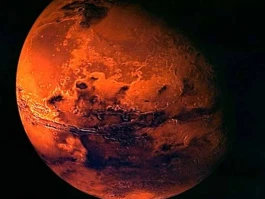
Okay, folks, buckle up, because I've got some news that's got me buzzing with that electric excitement—the kind that makes you want to stay up all night scribbling ideas on a whiteboard. We all know Mars, right? The rusty, dusty neighbor we've been eyeing for decades, wondering if it ever had a pulse. Well, a new study out of NYU Abu Dhabi is throwing a lifeline to the idea that Mars might've been habitable far longer than we ever dared to dream.
See, the common narrative is that Mars was once a warm, wet world, maybe even a cradle of life, but then it dried up, the atmosphere thinned, and it became the desolate place we see today. End of story, right? Wrong! This new research suggests that even after the lakes and rivers vanished, there were still pockets of water moving underground, creating these hidden, protected havens that could have supported microscopic life. It's like finding a secret oasis in the middle of the Sahara! This is one of the things that reminds me why I got into this field in the first place.
How did they figure this out? By comparing observations from the Curiosity rover in Gale Crater with naturally cemented dune formations right here on Earth, in the UAE desert. Imagine that: Martian dunes echoing earthly ones. What they found was that water from a nearby Martian mountain seeped into the dunes through tiny cracks, soaking the sand from below and leaving behind minerals like gypsum – the same stuff you find in our own deserts. These minerals? They're like time capsules, potentially trapping and preserving traces of organic material, making them prime targets for future missions hunting for signs of past life.
The Big Idea: A Second Act for Martian Life
But here's the real kicker, the "Big Idea" that sets my mind racing: This discovery isn't just about finding water; it's about reframing how we think about the timeline of habitability on Mars. It's not just a question of "was there ever life?" but "for how long could life have persisted?" Think of it like this: we often talk about Mars as a planet that "died," but maybe it's more accurate to say it went into a kind of suspended animation.
Dimitra Atri, the lead investigator on the study, said it best: "Our findings show that Mars didn't simply go from wet to dry. Even after its lakes and rivers disappeared, small amounts of water continued to move underground, creating protected environments that could have supported microscopic life."
And this is where it gets even more exciting. We know that Perseverance, NASA's most advanced rover, is already on Mars, collecting samples that could one day return to Earth. And while that mission is facing some budget challenges, the potential payoff is enormous. According to a report in Scientific American, the samples collected by Perseverance include the Cheyava Falls tube, retrieved in March 2024, which was collected in a region called Bright Angel. “Everybody’s probably most excited about the Bright Angel samples,” says Briony Horgan, a planetary scientist at Purdue University and part of the Perseverance science team. “They have potential biosignatures in them.” NASA’s Mars Sample Return Mission in Jeopardy as U.S. Considers Abandoning Retrieval
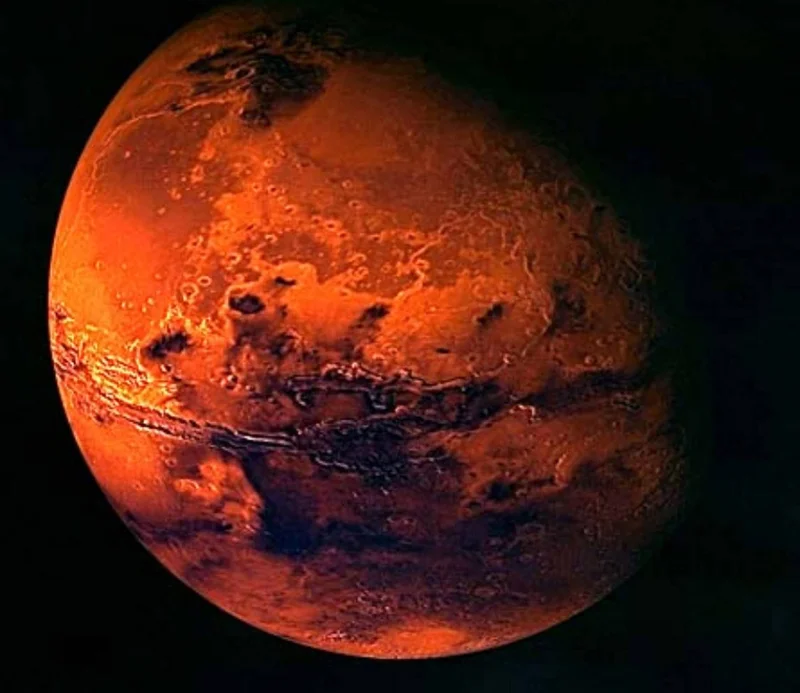
What if those samples contain evidence of life that persisted after the surface water disappeared? What if Mars wasn't a failed experiment in life, but a slow-burning one? It's a paradigm shift that could rewrite our understanding of life in the universe.
And it's not just about looking for past life. If there's still subsurface water on Mars, could there even be microbial life today? It's a long shot, sure, but this discovery opens the door to that possibility. And even if there isn't, these underground water sources could be a crucial resource for future human missions to Mars. Imagine, using Martian water to grow food, produce fuel, and create a self-sustaining colony. It's the stuff of science fiction, but it's starting to feel a little more like science fact.
Now, I know what some of you might be thinking: "Okay, Aris, that's all well and good, but what about the challenges? What about the radiation, the extreme temperatures, the lack of atmosphere?" And you're right, those are all significant hurdles. But here's the thing: life is incredibly resilient. We've found extremophiles on Earth that can survive in the most inhospitable environments imaginable, from boiling hot springs to frozen deserts. If life could find a way to survive on Mars, it would likely be in these protected subsurface environments. The role of extremophile microbiomes in terraforming Mars
And it's not just about finding life; it's about understanding how life adapts to extreme conditions. That knowledge could have profound implications for our understanding of life on Earth, and for our ability to create sustainable environments in the face of climate change.
Of course, with any discovery like this, there are ethical considerations. If we do find life on Mars, what are our responsibilities? Do we have the right to disturb it, to study it, to potentially contaminate it with our own microbes? These are questions we need to start grappling with now, before we even find definitive proof of life on Mars. It's a responsibility we owe not just to ourselves, but to any potential Martian life forms.
But let's not get bogged down in the what-ifs. Let's focus on the incredible potential of this discovery. Mars, a planet we thought was dead, might just be waiting to surprise us. The implications of this are just staggering – it means the gap between today and tomorrow is closing faster than we can even comprehend.
Mars: A Second Chance at Life?
This isn't just about Mars; it's about our place in the universe. It's about the possibility that life isn't some rare, fragile thing, but something that's far more common and resilient than we ever imagined. And that, my friends, is a vision worth striving for.